

Introduction
The Telenia widget library permits to connect your customer with operator logged on your TVox server using all licensed comunication channels.
The Telenia widget library delivers 2 functions:
- server connection interface.
- draw graphic elements to use server connection interface.
You can init server connection interface without use the graphic component.
Network
The server connection is initialized via https on port 443.
For video comunication WebRTC protocol is used. Ice server port comunication is 3478. Audio/video data is on DTLS through ports between 10000 and 20000.
External library used
This library and our demo need external library:
- RxJS - 5.5.8
- JQuery - 1.12.4 - this is necessary for IE11 compatibility
- Promise Polyfill - 7.1.2 - this is necessary for IE11 compatibility
For WebRTC on IE11 we check to load an Active-X powered by Frozen Mountain, as default this file is load from your server installation.
Widget
To use widget in your code you need to define a Widget object.
constructor(configuration: WidgetConfiguration)
In the constructor we need to pass the widget configuration.
| Properties | Type | Description |
|---|---|---|
| client | WidgetClient | Client object |
var widget = new Widget(widgetConf)
In this section are described the main methods of widget.
| Method | Description |
|---|---|
| onLoadClientComplete | widget is created |
| getServiceStatusForChannel | Service status monitor |
| widgetVisitUri | Pages of site visited by customer |
| sendCustomerIdentifier | Service and channel chosen by customer |
| disconnect | Disconnect widget from server |
| getChannelsEnabled | Get enabled channels from server |
onLoadClientComplete
onLoadClientComplete(action: function): void
This method requires a function that will be called after the creation of the widget object and when the client is ready to work.
var widget = new Widget(widgetConf)

widget.onLoadClientComplete(function() {

    console.log("I'm ready to work!")

    //for example we can log connection status
    widget.client.connectionEvent.subscribe(function (connectionEvent) {
        if(connectionEvent.connected) {
            console.log("Connected")
        } else {
            console.log("Not connected")
        }
    })
}
getServiceStatusForChannel
getServiceStatusForChannel(service: string, channel: MultiChannelType): Observable<ServiceStatus>
Get observable of service status by channel. After the subscription, all changes in the service status will be notified. Throw Error if service on channel is unmonitored as defined in configuration.
var widget = new Widget(widgetConf)

widget.onLoadClientComplete(function() {

    //for example we can log service status
    widget.client.getServiceStatusForChannel("service0001", "VIDEO").subscribe(function (statusForChannel) {
        if(statusForChannel && statusForChannel.service && statusForChannel.channelId && statusForChannel.status){
            console.log(`In channel ${statusForChannel.channelId} the status of service ${statusForChannel.service} is  ${statusForChannel.status}`)
        }
    })
}
widgetVisitUri
widgetVisitUri(linkableUri?: string, uri?: string, uriDisplay?: string): Promise
If the widget is displayed on many pages of the company site, the widget can send information to the server about the page of the site visited by the customer. The agent who answers a chat, phone call or video call with the customer can view this information in Tvox Web Client
document.location.href
var widget = new Widget(widgetConf)

widget.onLoadClientComplete(function() {
    widget.widgetVisitUri(document.location.href, document.location.pathname, document.title)
})
sendCustomerIdentifier
sendCustomerIdentifier(channel: MultiChannelType, service: string): void
When the customer decides which channel and service to use to communicate with contact center, the widget must inform the server of this decision.
Service is a string of service id.
var widget = new Widget(widgetConf)

widget.onLoadClientComplete(function() {
    widget.sendCustomerIdentifier("CHAT", "service0001");
})
disconnect
disconnect() :void
Disconnect widget from server
getChannelsEnabled
getChannelsEnabled(): { [key: string]: boolean }
were key is string of MultichannelType and boolean specify if channel is enabled or not on server
Chat
To use chat in your code you need to define a ChatSession object.
newChatSession(service: string, fields?: MultiChannelSessionCustomField[], chatCustomerDisplayName?: string, chatCustomerValue?: string): ChatSession
This object is the basis for a chat session and with this object we have access to all chat session methods. It is necessary to pass the chosen service and, optionally, the customer's name and e-mail. If you have already set up customer information in the configuration, there is no need to pass it now. If you don't pass any names and emails and have not set up customer information in the configuration, the agent on the web client will receive an anonymous chat request.
Param fields is not available in this version.
| Method | Description |
|---|---|
| createChatChannelSession | Start a chat session |
| getChatChannelSessionMonitor | Session status notifications |
| getChatChannelEventMonitor | Messages and events notifications |
| chatSendMessage | Send a message |
| chatChannelReceivedMessage | Marks an inbound message as received |
| chatChannelReadMessage | Marks an inbound message as read |
| chatSendRecapOfSession | Sends chat session history by e-mail |
| chatChannelSessionClose | Close chat session |
var chatSession = widget.newChatSession("support0001", null, "Mario Rossi", "rossimario@example.com");
createChatChannelSession
createChatChannelSession(): Promise<ChatChannelSession>
Send a request to TVox to start a chat session with an agent.
javascript
var chatSession = widget.newChatSession("support0001", null, "Mario Rossi", "rossimario@example.com");
chatSession.createChatChannelSession()
    .then((result) => {
        console.log(`Result of chat session creation: ${JSON.stringify(result)}`)
    }).catch((err) => {
        console.log(`Error of chat session creation: ${JSON.stringify(err)}`)
    })
getChatChannelSessionMonitor
getChatChannelSessionMonitor(): Observable<ChatChannelSession>;
Use this method to get notifications of session status. Subscribe on this method after createChatChannelSession
var chatSession = widget.newChatSession("support0001", null, "Mario Rossi", "rossimario@example.com");

var sessionMonior = chatSession.getChatChannelSessionMonitor()

chatSession.createChatChannelSession()
    .then((result) => {
        sessionMonior.subscribe((sessionMonitor) => {
            //for example we can log session state
            if (sessionMonitor.sessionState) {
                console.log(`Session state notified: ${sessionMonitor.sessionState}`)
            }
        })
    })
getChatChannelEventMonitor
getChatChannelEventMonitor(): LiveResult<ChatChannelEventMessage,ChatChannelEventMessage>
Use this method to get notifications of all messages of chat channel session. Subscribe on this method after createChatChannelSession
See LiveResult documentation to learn this interface
var chatSession = widget.newChatSession("support0001", null, "Mario Rossi", "rossimario@example.com");

var sessionMonior = chatSession.getChatChannelSessionMonitor()
var eventMonitor = chatSession.getChatChannelEventMonitor()

chatSession.createChatChannelSession()
    .then((result) => {
        sessionMonior.subscribe((sessionMonitor) => {

            //if session is close stop notification on event monitor
            if (sessionMonitor.sessionState && result.sessionState == "CLOSED") {
                eventMonitor.stopNotification();
            }
        })

        eventMonitor.result.subscribe((eventMonitorResult) => {
            console.log(`Event monitor result is: ${JSON.stringify(eventMonitorResult)}`);
        });

        eventMonitor.notification.subscribe((eventMonitorNotification) => {
            switch (notification.status) {
                case "WROTE":
                    // The message is wrote, check the direction and show the sent / received message
                    break
                case "COMPOSING":
                    // Someone is composing a message, check direction and show composing icon
                    break;
                case "IDLE":
                    // Nobody is composing a message, hide the composing icon
                    break;
            }
        })
    })
chatSendMessage
chatSendMessage(message: string, status: ChatChannelEventMessageStatus, notifyGreetingMessage: boolean): Promise<boolean>
Send a message to this chat session. You must pass the message, the status and notifyGreetingMessage. If notificationGreetingMessage is true, this message will be displayed as a message sent by the agent and not by the customer. Use this function to send a personalized welcome message from the widget to Tvox or to send the history of a previous chat with an external bot.
You can send message only when sessioMonitor.step.type is "CONNECTED".
var chatSession = widget.newChatSession("support0001", null, "Mario Rossi", "rossimario@example.com");

var sessionMonior = chatSession.getChatChannelSessionMonitor()

chatSession.createChatChannelSession()
    .then((result) => {
        sessionMonior.subscribe((sessionMonitor) => {
            if (sessionMonitor.sessionState && result.sessionState === "ACTIVE") {
                if(sessionMonitor.step && sessionMonitor.step.type && sessionMonitor.step.type === "CONNECTED" ) {
                    chatSession.chatSendMessage("Can I get some help, please?", "WROTE", false);
                }
            }
        })
    })
chatChannelReceivedMessage
chatChannelReceivedMessage(messageId: string): void
Inform the server that the widget received the message, messageId is the id of the message received.
chatChannelReadMessage
chatChannelReadMessage(messageId: string): void
Inform the server that the widget has read the message, messageId is the id of the message read.
chatSendRecapOfSession
chatSendRecapOfSession(mail: string): Promise<boolean>
Send a copy of chat session to customer by e-mail. To use this method, TVox must have MAIL channel enabled and configured for manage tickets.
chatChannelSessionClose
chatChannelSessionClose(): void
Close chat channel session and stop session notification
Video
To use the video channel on your code, you must be sure that the "webrtc" parameter is present in the server parameter of the widget configuration.
When a real-time session is established, use the WebrtcManager class to manage the devices.
| Method | Description |
|---|---|
| videoChannelSessionMonitor | Get monitor of video channel session |
| videoChannelSessionMonitorStop | Stop monitoring video channel session |
| videoChannelSessionNew | Create a video channel session |
| videoChannelSessionClose | Close a video channel session |
videoChannelSessionMonitor
videoChannelSessionMonitor(): Observable<VideoChannelSession>
Get monitor of video channel session
var monitor = widget.videoChannelSessionMonitor()
monitor.subscribe(function (result) {
    //for example, we can log the state of the session and if the session is IDLE, we stop monitoring the session
    if (result.state) {
        console.log(`Session state is ${result.state}`)
        if(result.state === 'IDLE') {
            widget.videoChannelSessionMonitorStop()
        }
    }
})
videoChannelSessionMonitorStop
videoChannelSessionMonitorStop(): void
Stop notification of video channel session
videoChannelSessionNew
videoChannelSessionNew(service: string, customerName?: string, customerMail?: string): Promise<string>
Create a video channel session. The service id must be specified. The customer's name and email are optional. If you have not already configured customer information in the widget configuration and do not set the customer name in this method, the agent in the TVox client will receive an anonymous video call
This method return a promise with session id.
videoChannelSessionClose
videoChannelSessionClose(sessionId: string): Promise<boolean>
close a video channel session. You must pass the session id of the active video session.
var sessionId = ''
widget.videoChannelSessionNew("support0001").then(function(result) {
    sessionId = result
})

...
...

widget.videoChannelSessionClose(sessionId).then(function(result){
    if(result) {
        console.log("Session closed")
    }
})
Call
To use the Call channel on your code, you must be sure that the "webrtc" parameter is present in the server parameter of the widget configuration.
When a real-time session is established, use the WebrtcManager class to manage the devices.
| Method | Description |
|---|---|
| callChannelSessionMonitor | Get monitor of call channel session |
| callChannelSessionMonitorStop | Stop monitoring call channel session |
| callChannelSessionNew | Create a call channel session |
| callChannelSessionClose | Close a call channel session |
callChannelSessionMonitor
public callChannelSessionMonitor(): Observable<CallChannelSession>
Get monitor of call channel session
callChannelSessionMonitorStop
Stop notification of call channel session
callChannelSessionNew
callChannelSessionNew(service: string, customerName?: string, customerMail?: string): Promise<string>
Create a call channel session. The service id must be specified. The customer's name and email are optional. If you have not already configured customer information in the widget configuration and do not set the customer name in this method, the agent in the TVox client will receive an anonymous call session.
This method return a promise with session id.
callChannelSessionClose
callChannelSessionClose(sessionId: string): Promise<boolean>
close a call channel session. You must pass the session id of the active call session.
WebRTCManager
This class manages webrtc sessions. With methods of this class it is possible to manage all the communication functions in real time.
toggleAudioMute
toggleAudioMute(sessionId: string): Promise<boolean>;
Enable / disable microphone. The session starts with audio enabled, the microphone is deactivated the first time you use this method, and then it is restored at the second use. You have to pass the sessionId.
widget.client.webrtc.toggleAudioMute(sessionId);
toggleVideoMute
toggleVideoMute(sessionId: string): Promise<boolean>;
Enable / disable webcam. The session starts with video enabled, the webcam is deactivated the first time you use this method, and then it is restored at the second use. You have to pass the sessionId.
widget.client.webrtc.toggleVideoMute(sessionId);
Interfaces
WidgetClient
| Parameter | Type | Description |
|---|---|---|
| connectionEvent | Observable<ConectionEvent> | Observable of connection state, event emitted when connection changed |
| webrtc | WebRTCManager | WebRTC manager |
| options | WidgetCong | Widget configutation |
WidgetConf
var widgetConf = {
    server: {
      url: "https://contact.teleniasoftware.com"
    },
    servicesConfiguration: [
        {
            type: "CHAT",
            services: [
                {
                    code: "service0001",
                    descritpion: "Commercial service"
                },
                {
                    code: "service0002",
                    descritpion: "Support service"
                }
            ]
        }
    ],
    customerInfo: {
        customerDisplayName: "Mario Rossi",
        customerValue: "rossimario@example.com"
    }
  };
| Parameter | Type | Description |
|---|---|---|
| server | ServerInterface | Configuration for server features |
| servicesConfiguration | ChannelServicesConfiguration [ ] | List of channels and services to use |
| customerInfo ? | CustomerInfo | Customer information |
| graphics ? | GraphicsConfigurationInterface | Graphic Conficuration |
ServerInterface
| Parameter | Type | Description | Default |
|---|---|---|---|
| url | string | Server address | |
| webrtc ? | WebrtcConfig | WebRTC session configuration object - required if you need a phone/video channel session | null |
| heartbeatInterval ? | number | server ping interval in milliseconds | 5000 ms |
| retryOptions ? | RetryOptionsInterface | Reconnecting configuration | Never stop retry every 10s |
var server = {
    url: "https://contact.teleniasoftware.com"
}
ChannelServicesConfiguration
Configurarion of single channel
| Parameter | Type | Description |
|---|---|---|
| type | MultiChannelType | Type of channel |
| services | ServiceConfiguration [] | Array of services and their configuration |
var channelServiceConfiguration = {
    type: "CHAT",
    services: [
        {
            code: "service0001",
            descritpion: "Servizio commerciale"
        },
        {
            code: "service0002",
            descritpion: "Servizio assistenza"
        }
    ]
}
ServiceConfiguration
Configurarion of services
| Parameter | Type | Description |
|---|---|---|
| code | string | code of service |
| description | string | description of service |
CustomerInfo
Customer information
| Parameter | Type | Description | Default |
|---|---|---|---|
| customerDisplayName | string | Customer display name | |
| customerFirstName ? | string | Customer first name | null |
| customerLastName ? | string | Customer last name | null |
| customerId ? | string | Customer id (ex id of address book) | null |
| customerValue ? | sring | Customer value (ex mail) | null |
| customerPhoneNumber ? | string | Customer phone number | null |
| customerCompany ? | string | Customer company | null |
var customerInfo = {
    customerDisplayName: "Mario Rossi",
    customerValue: "rossimario@example.com"
}
ServiceStatus
Service's status notified
| Parameter | Type | Description |
|---|---|---|
| channelConfiguration ? | ConfigurationStatus | Channel configuration status |
| channelId ? | MultiChannelType | Channel id |
| service ? | string | Service code |
| serviceConfiguration? | ServiceConfigurationStatus | Service configuration status |
| status ? | ServiceStatusValue | Service status |
ConnectionEvent
| Parameter | Type | Description |
|---|---|---|
| connected | boolean | Connection's state - connected or not |
LiveResult
LiveResult
LiveResult is an interface used in sessions for notification subscribes. It is composed by two observables, one for the result of notification request and one for future notifications. When notifications aren't needed yet, the method stopNotification stops them.
| Parameter | Type | Description |
|---|---|---|
| result | Observable< R > | Subscribe to this observable for send request and receive request result |
| notification | Observable< L > | Subscribe to this observable for receive futures notifications |
| stopNotification: () | Promise |
Request to stop notifications |
ChatChannelEventMessage
Chat message interface
| Parameter | Type | Description |
|---|---|---|
| message? | string | Exchanged message |
| messageType? | ChatMessageType | Type of message identify normal message or open/closed session message |
| status? | ChatChannelEventMessageStatus | Status of message by sender |
| createdAt? | string | Event created at, date as string |
| direction? | Direction | Event direction |
| id? | string | Event id |
| sessionId? | string | Event session id |
ChatChannelSession
Extends MultiChannelSession
VideoChannelSession
Extends MultiChannelSession
| Parameter | Type | Description |
|---|---|---|
| start? | String | call's start time as string |
| time? | String | system time as string |
| state? | CallState | call's state |
CallChannelSession
Extends MultiChannelSession
| Parameter | Type | Description |
|---|---|---|
| start? | String | call's start time as string |
| time? | String | system time as string |
| state? | CallState | call's state |
MultiChannelSession
| Parameter | Type | Description |
|---|---|---|
| id | string | Session id |
| service? | string | Session's current service |
| sessionState? | MultiChannelState | Session state |
| step? | MultiChannelStepUnion | Step to do |
MultiChannelStepUnion
Step for channel session, this interface is generic for all channel session.
MultiChannelStepQueue | MultiChannelStepPlay | MultiChannelStep | MultiChannelStepToUrl | MultiChannelStepInactivityTimeout
MultiChannelStepQueue
Queue step, when session is on queue. Extends MultiChannelStep
| Parameter | Type | Description |
|---|---|---|
| queuePosition ? | number | Channel session's queue position - if null information is not available. |
MultiChannelStepPlay
Play step, when session is play something to customer. Extends MultiChannelStep
| Parameter | Type | Description |
|---|---|---|
| welcomeMessage ? | string | Message on waiting the right connect state. |
MultiChannelStepToUrl
Session's action that say to change page uri. Please redirect to uri. Extends MultiChannelStep
| Parameter | Type | Description |
|---|---|---|
| uri? | string | Uri to redirect widget page |
MultiChannelStepInactivityTimeout
Connection is expiring for inactivity timeout. Extends MultiChannelStep
| Parameter | Type | Description |
|---|---|---|
| inactivityExpireDatetime? | number | Time when session expired |
MultiChannelStep
| Parameter | Type | Description |
|---|---|---|
| step? | number | Step of session |
| type? | MultiChannelStepType | Step's type |
WebrtcConfig
Webrtc configuration
| Parameter | Type | Description |
|---|---|---|
| enabled | boolean | If WebRTC is enabled or not |
| trickleIcePolicy? | TrickleIcePolicy | trickle ice policy |
| iceGatherPolicy? | IceGatherPolicy | Ice gather policy |
| videoContainer? | HTMLElement | Video output html container |
Enum
MultiChannelType
Enum of channel type
| Enum | Value | Description |
|---|---|---|
| PHONE_CALL | "PHONE_CALL" | Phone channel |
| VIDEO | "VIDEO" | Video channel |
| CHAT | "CHAT" | Chat channel |
| "MAIL" | Ticket channel | |
| CALLBACK | "CALLBACK" | Call back channel |
ConfigurationStatus
Service or channel configuration
| Enum | Value | Description |
|---|---|---|
| DISABLED | "DISABLED" | Disabled |
| ENABLED | "ENABLED" | Enabled |
| NOT_FOUND | "NOT_FOUND" | Not found |
| NO_LICENSE | "NO_LICENSE" | No license present on server |
| FAILED | "FAILED" | Generic error |
ServiceStatusValue
Service status
| Enum | Value | Description |
|---|---|---|
| ACTIVE | "ACTIVE" | Service open with logged user |
| OUT_OF_SERVICE | "OUT_OF_SERVICE" | Service open without logged user |
| OVERTIME | "OVERTIME" | Service closed, out of calendar defined on service |
| FAILED | "FAILED" | Generic error |
ChatChannelEventMessageStatus
| Enum | Value | Description |
|---|---|---|
| WROTE | "WROTE" | Message wrote |
| COMPOSING | "COMPOSING" | Message on composing |
| IDLE | "IDLE" | No message composing |
ChatMessageType
| Enum | Value |
|---|---|
| MESSAGE | "MESSAGE" |
| CLOSED_SESSION | "CLOSED_SESSION" |
| OPEN_SESSION | "OPEN_SESSION" |
Direction
| Enum | Value |
|---|---|
| INBOUND | "INBOUND" |
| OUTBOUND | "OUTBOUND" |
MultiChannelState
| Enum | Value |
|---|---|
| ACTIVE | "ACTIVE" |
| CLOSED | "CLOSED" |
MultiChannelStepType
| Enum | Value | Description |
|---|---|---|
| QUEUE | "QUEUE" | Session on queue |
| PLAY | "PLAY" | Session to play message (text, audio, video) |
| CONNECTING | "CONNECTING" | Session to connecting to operator |
| CONNECTED | "CONNECTED" | Session is connected |
| TO_URL | "TO_URL" | Redirect widget page to uri |
| INACTIVE_TIMEOUT | "INACTIVE_TIMEOUT" | Notify inactive state after timeout |
| ACTIVE_FROM_TIMEOUT | "ACTIVE_FROM_TIMEOUT" | Notify acrive state after timeout |
| MAX_DURATION_TIMEOUT | "MAX_DURATION_TIMEOUT" | Notify inactive state after max duration timeout |
TrickleIcePolicy
| Enum | Value |
|---|---|
| 1 | "NotSupported" |
| 2 | "FullTrickle" |
| 3 | "HalfTrickle" |
IceGatherPolicy
| Enum | Value |
|---|---|
| 1 | "All" |
| 2 | "NoHost" |
| 3 | "Relay" |
CallState
| Enum | Value | Description |
|---|---|---|
| NEW_INBOUND | "NEW_INBOUND" | New inbound call |
| NEW_OUTBOUND | "NEW_OUTBOUND" | New outbound call |
| CONNECTED | "CONNECTED" | Call connected, answered |
| CONFERENCED | "CONFERENCED" | Call transfer to conference |
| HOLD | "HOLD" | Call pause |
| IDLE | "IDLE" | Call close |
Use and Demo
The widget directory is made up of 3 directories
- cross-storage
- dist
- demo
cross-storage use is not available in this version.
The javascript library to be imported into your project is in dist/bundle.
To show an example of using the widget library, a demo per channel is available in the source code.
Chat & Bot integration
The chat demo shows how to instantiate a chat session and how to integrate an external chat bot with the widget. The sources of this demo are:
demo/chat.htmldemo/lib/wtest_chat.js
wtest_chat.js have a lot of comments for show how to use the library.
Before starting the demo you must configure 3 services with chat channel on TVox and you must configure an agent in a skillset with which these 3 services are associated.
When you start the demo you must set:
- the TVox url
- 3 services configured previously on your TVox
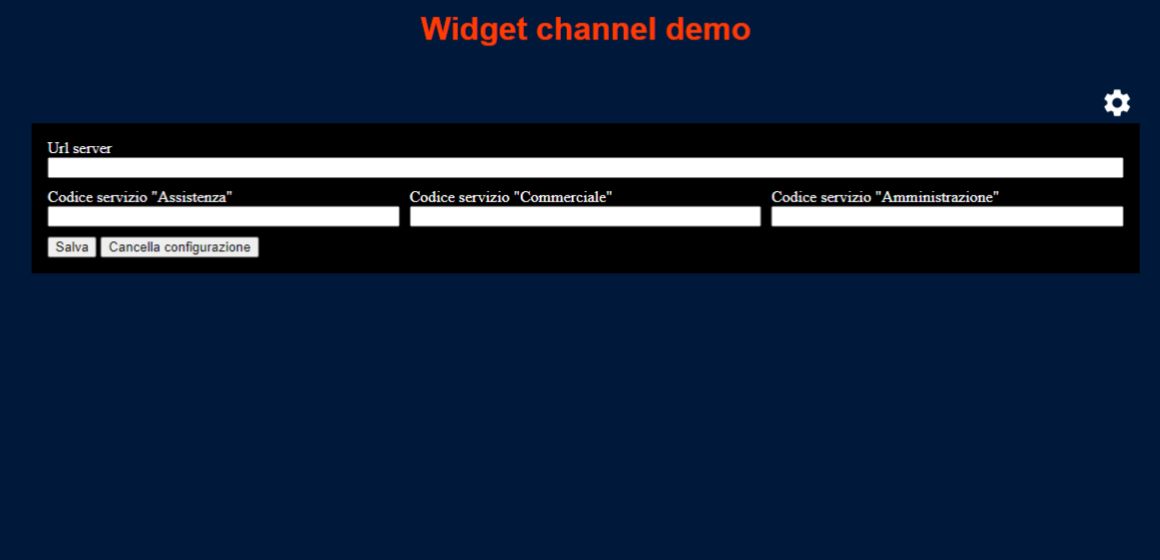
The TVox url is the TVox address like "test.teleniasoftware.com" or static IP like "X.X.X.X".
The 3 services, in this case "Assistenza","Commerciale","Amministrazione", are 3 contact center services with chat channel enabled. You have to configure them on the Tvox settings.
On the left of the screen there is an area with chat session, on the right there is an area with session log.
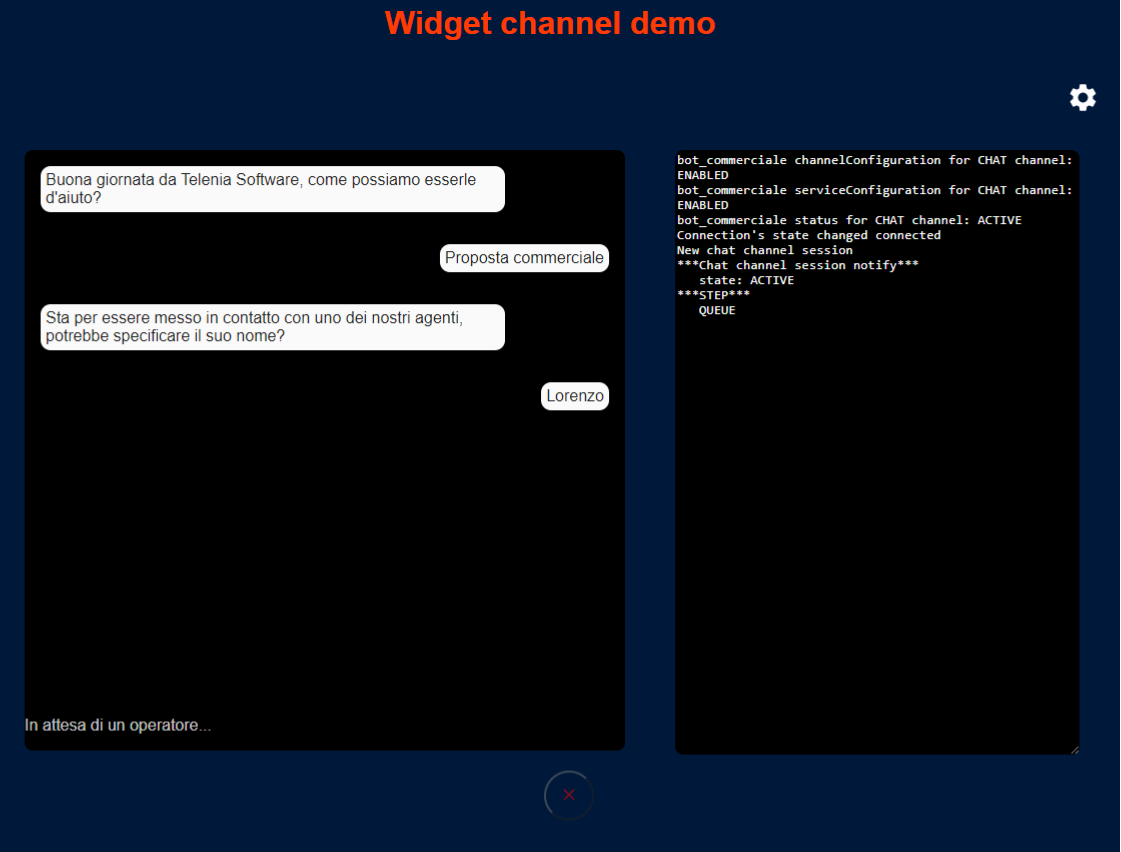
Send Bot History to TVox
To send the chat history about customer and bot conversation, you have to use chatSendMessage method. This method has a Boolean notifyGreetingMessage parameter. If notificationGreetingMessage is true, this message will be displayed as a message sent by the agent and not by the customer. Therefore, if you use this parameter, when the agent replies to the chat session, you can send in cronologiacl order all the messages previously written by the customer with notificationGreetingMessage set to false and send the questions asked by the bot by setting notificationGreetingMessage to true.
In the demo example the method sendBotMessages in demo/lib/wtest_chat.js shows how to send the history to agent on TVox.
Download the library pack to start demo now
Video
Available soon...